




| March 4, 2026
The Economic Power of Federated Threat Intelligence
Introduction: Why Policy Matters to Developers
As developers of the MISP project, we spend most of our time thinking about UUIDs, JSON schemas, and API synchronization performance. However, every so often, a piece of academic research comes along that reminds us why this work matters beyond the code.
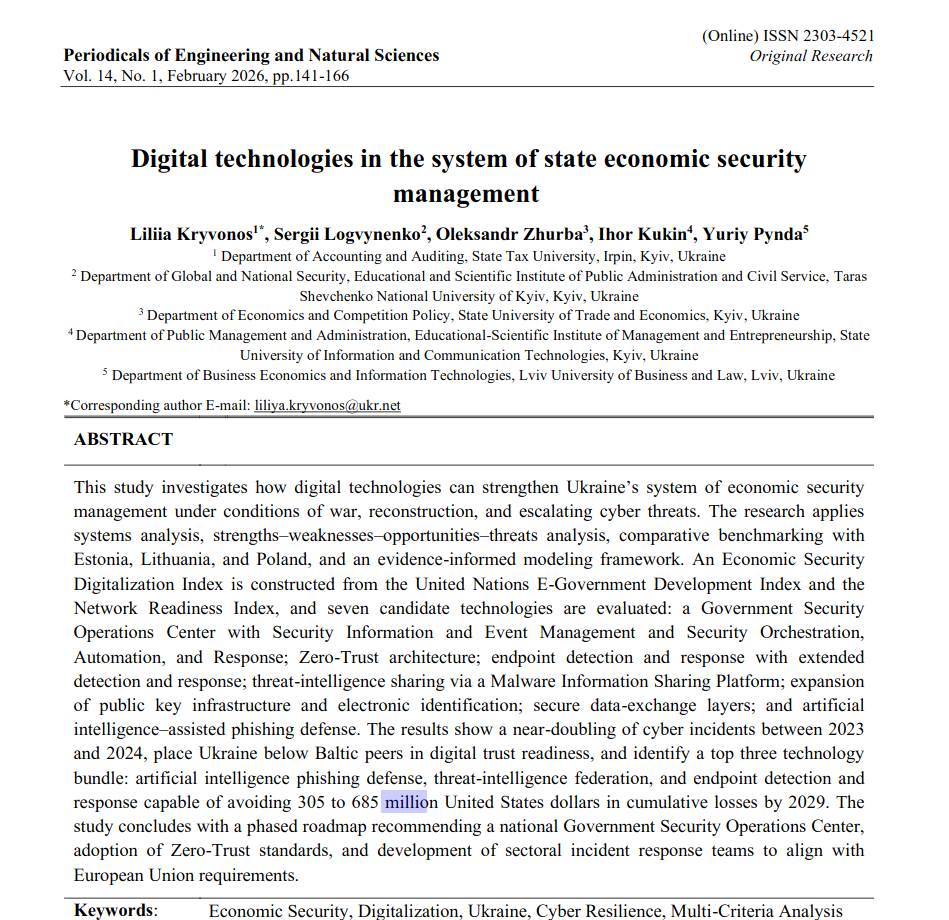
Today, we are looking at a recent paper titled "Digital technologies in the system of state economic security management" (Kryvonos et al., 2026). This research provides a compelling economic argument for what we have advocated for years: Federation is the key to national resilience.
Internal Review: From the MISP Core Team’s Eyes
From our perspective, the paper by Kryvonos et al. is a significant validation of our architectural philosophy. Here are our key takeaways:
The “Network Effect” as a Security Control
The authors correctly identify that threat intelligence is not a static resource. Its value grows exponentially with the number of participants. By using MISP to bridge the gap between central ministries, regional administrations, and State-Owned Enterprises (SOEs), the “time-to-block” for new threats is drastically reduced.
The Economic ROI of Open Standards
The study places MISP in a “top-tier” technology bundle for economic protection. It projects that a synchronized defense (centered on MISP federation) can help avoid between $305M and $685M in cumulative losses over a four-year period. For an open-source project, seeing these numbers attached to the “sharing is caring” model is incredibly rewarding.
Addressing the “Federation Gap”
The paper highlights a critical bottleneck: organizations often run isolated MISP instances without synchronizing them. We agree with the authors that federation is not just a feature; it is a strategic requirement. Without automated exchange between the “center” and the “periphery,” the system remains a collection of silos rather than a unified shield.
Building the Shield — Why Federated MISP is the Future
Beyond Silos: How Federated Threat Intelligence Safeguards the Modern State
In the fast-moving world of cyber defense, we often talk about the latest “silver bullet” tools—AI-driven detection, Zero-Trust architectures, and next-gen XDR. While these are vital, a recent paper titled "Digital technologies in the system of state economic security management" (Kryvonos et al., 2026) reminds us of an even more foundational truth: we are stronger when we defend together.
The Economic Power of Sharing
The researchers found that a national-scale federation of threat intelligence—specifically using MISP is one of the most effective ways to protect a nation’s economic stability.
In fact, when combined with AI phishing defense and EDR, this bundle is projected to safeguard hundreds of millions of dollars in national assets by 2029. Why? Because it targets “dwell time.” By sharing Indicators of Compromise (IoCs) in real-time across a federated network, a threat detected at a regional office can be blocked at a national energy provider in seconds.
The Magic of Federation
The paper points out a common pitfall: many organizations have their own MISP instance, but they aren’t talking to each other. This creates “situational awareness fragmentation.”
Federated MISP changes the game by:
- Eliminating Redundancy: Why should ten different ministries waste time analyzing the same phishing campaign?
- Supporting the “Long Tail”: Smaller regional administrations often lack the resources to hunt for advanced threats. Federation allows them to “consume” high-quality intelligence generated by central CSIRTs.
- Low Cost, High ROI: The study ranked MISP as one of the most cost-effective solutions available, featuring a rapid “payback” period.
A Roadmap to Resilience
The paper proposes a phased roadmap moving from initial “quick-win” controls to full MISP federation by late 2026. This isn’t just a technical recommendation; it’s an institutional one.
At the MISP core team, our mission has always been to provide the tools that make this collaboration possible. As this research proves, federating our intelligence is no longer just a “best practice”. It is a strategic economic necessity for any modern state.
Let’s stop defending in isolation. Let’s start federating.