




By Christian Studer March 13, 2026
MISP-STIX v2026.3.13: Improved Indicator-Observable Matching and Expanded STIX Coverage
Introduction
misp-stix is the Python library powering bidirectional conversion between MISP and STIX (versions 1.x, 2.0, and 2.1).
It is used by MISP core software, available as misp-stix on PyPI, and also available directly as a conversion service on cti-transmute.org.
The headline features are a new indicator-observable fingerprinting system, dual indicator + observed data export, expanded MISP object support, and ACS marking definition handling.
What This Release Means for the MISP Community
Better Round-Trip Fidelity
The biggest challenge in MISP-to-STIX conversion has always been preserving meaning across format boundaries. When a MISP attribute has to_ids=True, that flag carries operational significance: it tells analysts this indicator should be used for detection. Previously, this information could be lost or ambiguous during round-trip conversion. With this release, the library now intelligently matches STIX Indicators against Observable objects and restores the to_ids flag when importing back into MISP, dramatically improving round-trip fidelity as well as conversion accuracy for STIX data generated from third-party sources.
More Object Types, Fewer Gaps
Every unsupported object type is a gap where threat intelligence gets dropped during conversion. This release closes several of those gaps: artifact objects (with payload_bin support), malware and malware-analysis SDOs, and http-request objects from network traffic observables. Combined with the expanded indicator pattern parsing (covering x509 certificates, registry keys, email messages, PE extensions, and more), significantly more of your MISP data now survives the journey to and from STIX.
ACS Marking Support
For organisations working with Access Control Specification (ACS) markings, this release adds full round-trip support. ACS marking extension definitions in STIX 2.1 are converted to MISP Galaxy Clusters on import, and those clusters are converted back to proper STIX 2.1 Marking Definitions on export. This is particularly relevant for government and defence sector users who rely on ACS markings for information sharing policies.
Cleaner, More Reliable Output
Several quality-of-life improvements make the exported STIX content cleaner: the to_ids label has been removed from STIX objects (since it no longer makes sense to include it on a MISP object exported to STIX when the attributes with to_ids=True are already described in the Indicator pattern), relationship deduplication prevents redundant links, and deterministic UUID generation ensures consistent output across runs.
Feature Deep-Dives
Indicator-Observable Fingerprinting
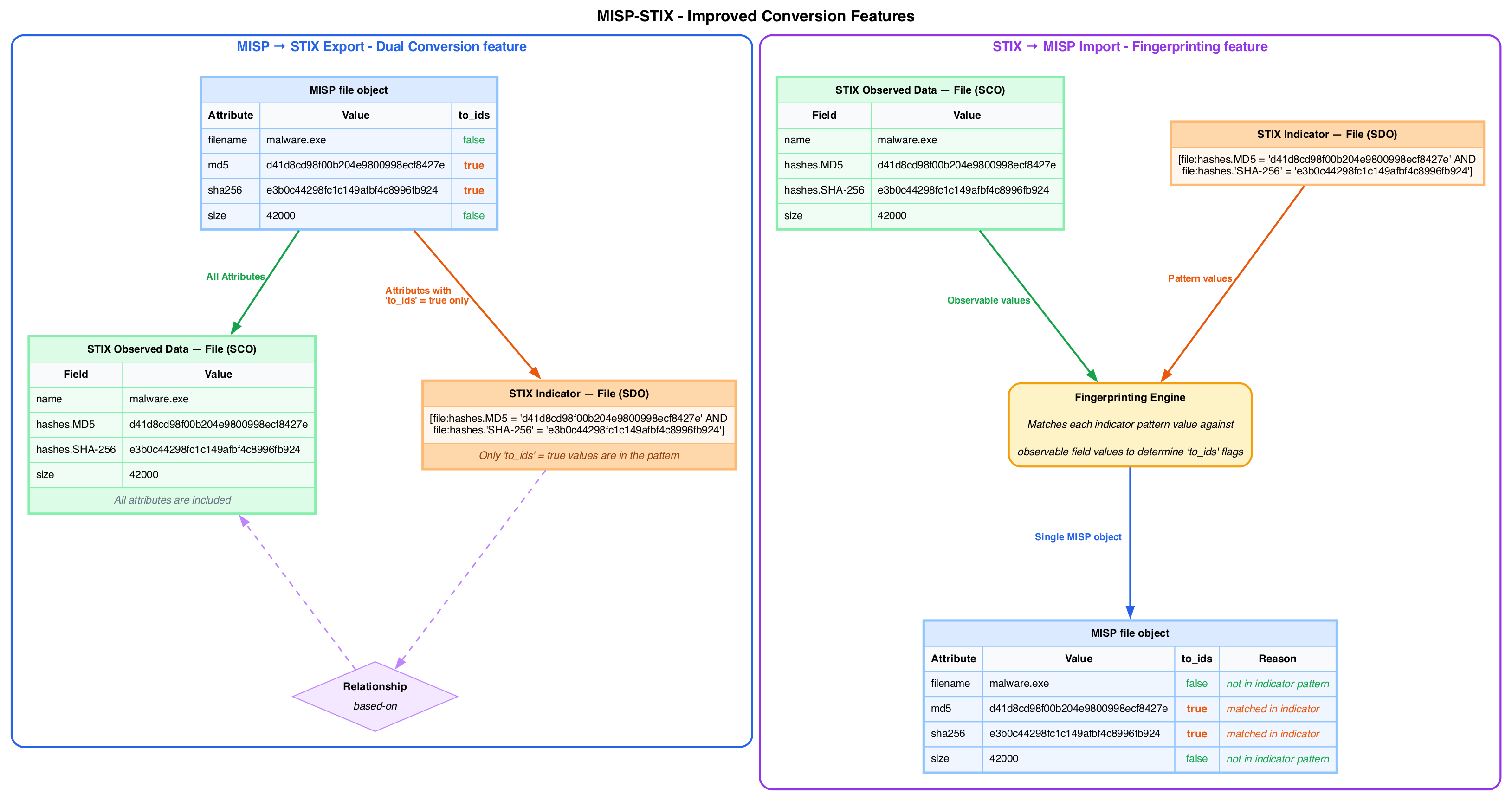
The core innovation in this release is a fingerprinting system that links STIX Indicators with their corresponding Observable objects. The problem it solves: when a STIX bundle contains both an Indicator (with a pattern like [file:hashes.'SHA-256' = 'abc123...']) and a separate File observable with the same hash, these represent the same piece of intelligence — but nothing in the STIX format explicitly connects them in a way that maps back to MISP’s to_ids concept.
The fingerprinting system compares pattern values from Indicators against field values in Observable objects. When a match is found, the resulting MISP attribute gets to_ids=True and the Indicator ID is stored in the attribute’s comment for traceability.
This works differently for internal vs external STIX content:
- Internal (MISP-generated STIX): The library can reconstruct the original MISP structure with high fidelity
- External (third-party STIX): The library uses pattern matching heuristics to infer the indicator-observable relationship
Dual Export: Indicator + Observed Data
Previously, a MISP attribute with to_ids=True was exported as either an Indicator or an Observed Data object. Now it generates both, connected by a STIX Relationship. This better represents the dual nature of the data: what was seen versus the detection pattern.
This is especially relevant for MISP objects with multiple attributes set to to_ids=True (e.g., a file object with multiple hashes and filename attributes). All attributes are now represented as STIX Observable objects, while an Indicator object describes the detection pattern.
The export pipeline also now:
- Applies default
to_idsvalues per attribute type (so attributes without an explicit flag get a sensible default) - Deduplicates relationships (if an Observed Data object already has a relationship to another object, the corresponding Indicator won’t create a duplicate)
- Generates deterministic relationship IDs for reproducible output
New Object Types Supported
Artifact: Full round-trip support for STIX Artifact objects, including payload_bin field handling. On import, Artifact observables and indicators are converted to MISP artifact objects. On export, the reverse conversion produces valid STIX Artifacts.
Malware & Malware Analysis: MISP malware objects now export to STIX 2.x Malware SDOs, and malware-analysis objects export to STIX 2.1 MalwareAnalysis SDOs with proper kill chain handling.
HTTP Request: External network-traffic observables with HTTP request extensions are now imported as MISP http-request objects, preserving request method, URI, headers, and other HTTP-specific fields.
ACS Marking Definition Support
ACS (Access Control Specification) markings define sharing policies for classified or sensitive information. This release adds:
- Import: STIX 2.1 ACS marking extension definitions are converted to MISP Galaxy Clusters, grouped under a single Galaxy. Multiple
further_sharingrules are now properly handled. Marking definitions referenced in Report or Groupingobject_refsare correctly resolved. - Export: Custom ACS marking Galaxy Clusters are converted back to STIX 2.1 Marking Definitions with the proper extension structure. For STIX 2.0, they are exported as custom marking definition objects.
Pattern Parsing Improvements
The STIX pattern parser has been significantly improved to handle complex patterns across a wide range of observable types:
- x509 certificates: Improved handling of hash properties within certificate patterns
- Processes: Proper attribute extraction from process patterns
- Registry keys: Fixed value parsing for patterns with list indexes describing embedded values
- Email messages: Correct conversion of email patterns to MISP
emailobjects - Domain-name + IP: Proper differentiation between
domain-ipobjects and simpledomainattributes - Autonomous systems: Fixed AS name and number extraction
- Socket extensions: Correct parsing of
socket-extpatterns - Network traffic: Unified handling of network connection and network traffic patterns
- MAC addresses: New indicator-to-attribute conversion support
- Mutex objects: Improved pattern parsing
- PE extensions: Better extraction of PE header and section data from file indicators
- Artifact
payload_bin: Proper base64 payload extraction from artifact patterns
Release at a Glance
- Almost 350 commits across 120 files changed
- ~89,000 lines added, ~48,000 lines removed
- New
AbstractParserbase class unifying error/warning handling across all parsers - Deterministic v5 UUID generation for reproducible conversions
- Default MISP event validation before conversion and export to STIX
For the full mapping documentation, see the documentation/mapping/ directory.